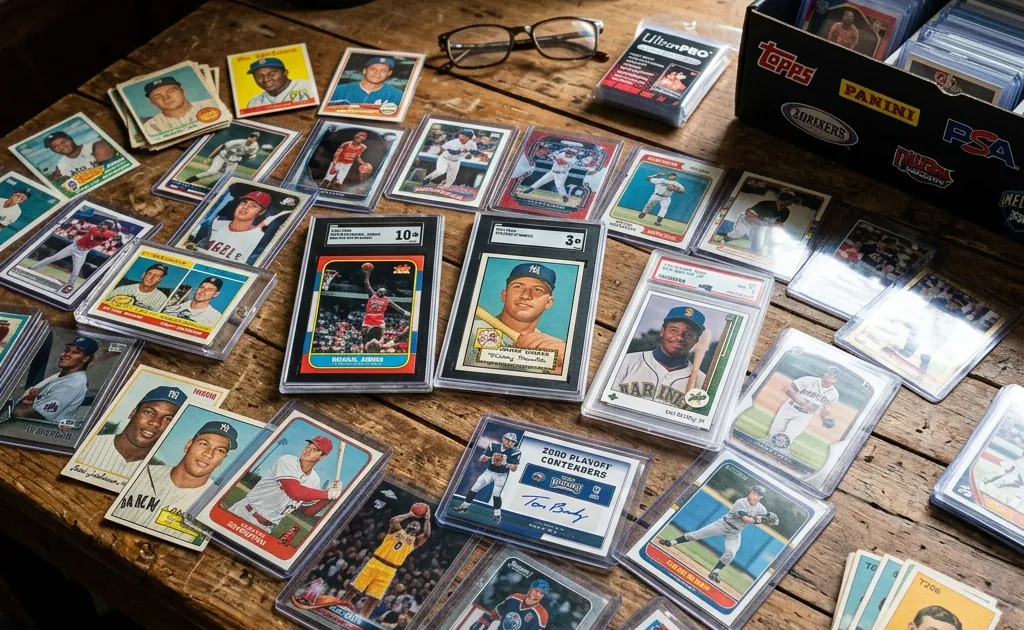
To identify a basketball Prizm parallel, first record the product year, player, card number, and every printed parallel or serial clue. Then compare the card with the checklist for that exact release. A color alone is not enough: the same color word can describe different products, inserts, or numbering systems.
This guide is an identification workflow. It does not authenticate a card, promise a print run, or assign a price. Use the basketball card scanner for a candidate match, then verify the printed evidence yourself.
The identification packet
Photograph the complete front and back in neutral light. Keep the original files and record the date. Write down what is visible before searching:
| Field | Record | Why it matters |
|---|---|---|
| Release year | Copyright year and suspected product year | Similar designs recur in later releases |
| Product | Prizm Basketball, Draft Picks, Fast Break, or another product | A checklist is product-specific |
| Card number | Full number, including letters | Base and insert numbers can overlap |
| Player | Exact spelling and team shown | Traded players and rookie cards need context |
| Parallel clues | Color, pattern, finish, and printed name | A visual color is only a clue |
| Serial stamp | Full format such as 17/99 | The denominator describes that stamped card’s limit, not every parallel |
Leave a field blank when it is unreadable. A blank answer is safer than copying a number from a similar listing.
Product comes before parallel
Panini has issued Prizm-branded basketball products across different seasons and configurations. Start with the front logo, the back copyright line, and the exact product wording. Check the Panini America checklist and product resources for the relevant release when available. As a concrete cross-check, the 2023–24 checklist published by Beckett identifies a 300-card base set and lists named parallels such as Silver, Green Ice, and Blue Prizms /199; use the release title and section rather than assuming those names apply to every year. The checklist title, release year, and section heading should all agree with your card.
Do not treat a familiar design as proof of a particular season. A retro-style insert can resemble a base card, and a retail configuration can have parallels absent from a hobby checklist. Compare the card number and design details against the release document rather than searching only the player’s name.
Base card, insert, and parallel
A base card belongs to the main numbered checklist. An insert has its own set name or numbering and may use a different design. A parallel keeps the base card’s subject and usually its number while changing the finish, color, pattern, or scarcity. These categories can coexist in one product.
Ask three questions:
- Does the card number appear in the base checklist or an insert section?
- Does the card name or checklist row identify a parallel?
- Does the physical finish match the listed variation, or is the difference only lighting?
Record the answer as “base identity confirmed; parallel unresolved” when necessary. That is a useful result for later pricing.
Visual clues that require verification
Silver, red, green, blue, shimmer, cracked ice, and wave patterns are common descriptive terms, but names vary by product and year. A red border may be a named parallel, a retail-only version, or an insert design. A photograph under warm light can change the apparent color.
Use the following comparison order:
- Compare the border and background pattern with a checklist image or official product description.
- Look for a printed parallel name on the back or packaging.
- Check whether the card has a serial stamp and copy it exactly.
- Confirm that the subject and number match the same product section.
Never infer a print run from a color. If the card has no serial stamp and the checklist does not state a print run, record scarcity as unverified.
Serial-number worksheet
Use this worksheet for each card:
| Observation | Your note |
|---|---|
| Product and year | |
| Player and team | |
| Checklist number | |
| Printed parallel wording | |
| Serial stamp, including denominator | |
| Front pattern and finish | |
| Back pattern and finish | |
| Checklist URL and section | |
| Remaining uncertainty |
The stamp 17/99 is an illustrative format, not a reported sale or a claim about a particular Prizm release. It means the object in front of you carries that stamp; it does not identify the product by itself.
Common lookalikes
Some errors recur because sellers use broad titles. A base card may be listed as a “silver” card when the seller means a reflective finish. A rookie card from a collegiate product may be described as NBA Prizm. A numbered insert may be grouped with the base set. Search results can repeat those mistakes.
Compare the back design, copyright line, and number, not just the front color. If two candidates remain, keep both in your ledger and state what evidence would separate them. Do not select the higher-priced candidate because it is more exciting.
Condition is a separate question
After identity is established, inspect centering, corners, edges, and surface. PSA explains its grading approach in its grading standards; use that as a condition reference, not as an automatic prediction of a grade. Prizm surfaces can show print lines, dimples, scratches, or edge chipping that are difficult to see in a listing photo.
Take straight-on front and back photos and angled surface photos. Do not call a card “gem mint” from a scanner suggestion or one photograph. Keep condition notes separate from identity notes so an uncertain parallel does not become an inflated value estimate.
Move from identification to research
Once the packet is complete, use the sports card valuation guide to compare recent completed sales. For a fair basketball comparison, match product, player, card number, parallel, serial range, and condition. A raw card should not be compared with a graded card as if the labels were interchangeable. The raw vs. graded value guide can help with that decision.
Use the sold-price versus asking-price guide to separate an advertised amount from a completed transaction. Keep the sale date, condition, grade, and source with each observation. Do not average unmatched cards merely because they share a player.
A final decision tree
Can you read the product and year? If no, photograph the back and seek a checklist match. If yes, continue.
Does the number match a base or insert section? If no, keep the identity unresolved. If yes, continue.
Is the parallel named or serial-numbered in a relevant source? If no, describe only the observable finish. If yes, record the exact name and source.
Do condition and grade match the comparison cards? If no, do not use those sales as direct comps. If yes, document them and continue.
That sequence protects you from the most common error: treating a visually similar card as a precisely identified, high-value variation. A careful record is useful even when the final parallel remains unresolved.
Packaging and seller language
Packaging can provide a lead, especially when a card came from a sealed box or a retail format, but it is supporting evidence. Save a photograph of the wrapper or box label if you have it. Record the configuration only when the label names it. Do not infer a hobby-only parallel from a seller’s description or from the fact that the card has a reflective finish.
Marketplace titles are discovery aids, not checklists. Sellers may omit a prefix, shorten a parallel name, or use a team nickname. Search several word orders, then return to the physical card and the release document. If the marketplace uses a broader category than the manufacturer, keep the broader label in a separate note so it cannot silently replace the verified product name.
Photographing reflective cards
Prizm surfaces create glare that can hide a pattern or a small serial number. Photograph the card straight on with diffuse light, then take an angled image that shows the surface. Move the light rather than the card when possible. Keep both images with the identification packet and note which detail each image supports.
Do not edit away print lines, scratches, or edge wear. Cropping is fine for a research detail, but preserve the full original. An edited image can help a reader see a pattern; it cannot prove that a missing number or stamp was present.
When to stop and ask for help
Stop the identification workflow when the card may be counterfeit, altered, trimmed, or missing a label needed for a purchase decision. A checklist can show that a design existed; it cannot establish that the object in hand is genuine. For a significant transaction, use an established authentication or grading service and keep its report separate from this editorial worksheet.
If a card is in a sealed slab, do not remove it to inspect the back. Record the holder label and certification information, then compare the label with the visible card. If the label and card disagree, document the discrepancy rather than selecting the more valuable description.
Publishable notes versus private hypotheses
Keep a clear distinction between what you can quote and what you are considering. A publishable note names the source and describes the observable feature. A private hypothesis may say “possibly a blue wave,” but it should not be used in a title, price estimate, or social post until a checklist or authoritative release reference supports it.
That discipline matters because a mistaken parallel name can spread through copied listings. A careful uncertainty statement gives the next collector a way to reproduce the research and correct it when a better source appears.
Editorial evidence note
Sources and links were reviewed on October 28, 2026. Product availability and checklist URLs can change; recheck the relevant release document before publishing a price claim. The SportsCardValue Editorial Team reviews identification workflows and does not provide authentication or certified appraisals.
Identify and Research Your Sports Cards
Download the Sports Card Scanner & Value app to identify, catalog, and track baseball, basketball, and football cards. Confirm the exact card and condition before relying on an estimate.