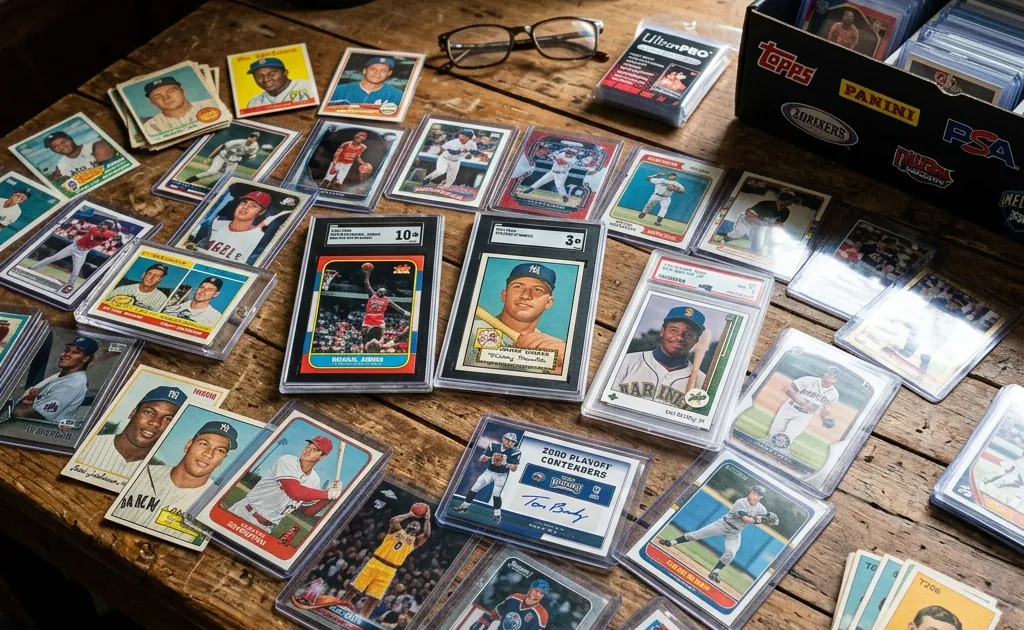
A sports card becomes valuable when buyers want that exact card and the available evidence supports the demand. The useful questions are not simply “Is the player famous?” or “Does the card look old?” Confirm the year, manufacturer, product, card number, variation, and format first. Then assess scarcity, physical condition, cultural or sporting demand, and recent completed sales as separate pieces of evidence.
This guide explains the forces behind value so you can decide what to verify next. It does not assign a price, predict a return, or turn a photograph into an appraisal. A card can be scarce but unpopular, popular but common, or attractive but incorrectly identified. A defensible conclusion records those differences.
The evidence model
Use this matrix before looking for a number. “Strong” means the evidence is specific and documented, not that it guarantees a higher result.
| Factor | What to verify | Strong evidence | Common mistake |
|---|---|---|---|
| Identity | Year, maker, product, card number, subject, variation | Front and back matched to an official checklist or slab label | Comparing a similar image from another release |
| Scarcity | Parallel, insert, serial marking, print information, distribution | Manufacturer checklist, odds, or a clearly printed serial | Calling every shiny card rare or inferring a print run |
| Condition | Corners, edges, surface, centering, alterations, raw or graded status | Clear front/back images or a grading-service label and cert check | Treating “looks clean” as a guaranteed grade |
| Demand | Player, team, milestone, era, set interest, collector use | Repeated relevant search and completed-sale evidence | Assuming fame alone creates liquidity |
| Market evidence | Similar completed transactions and dates | Same card, variation, format, and comparable condition | Using an active asking price as a sale |
The factors interact, but they should remain visible in your notes. If the card number is unresolved, pause the value conclusion even when the player is obvious. If the variation is confirmed but there are no close sales, state that evidence is sparse rather than filling the gap with a dramatic estimate.
Identity comes before value
Start with the complete front and back. Record the player or subject, team, season clue, manufacturer, product name, card number, rookie or prospect wording, insert name, parallel finish, serial stamp, autograph or memorabilia language, and any copyright line. A card number is useful, but it is not unique across every product made in a year.
The baseball identification guide shows how to keep candidate matches and disconfirming evidence in an identification ledger. The SportsCardValue scanner can surface a candidate, but it is a research starting point. Compare the candidate with the printed card and an official checklist before researching sales.
For a basketball Prizm card, for example, base, insert, and parallel status may depend on finish, wording, and checklist placement. For a football patch or rookie card, the product and release can matter as much as the player name. Search the complete identity rather than the shortest memorable phrase.
Scarcity is a documented property
Scarcity can come from a limited parallel, a serial-numbered version, an insert with lower distribution, a short-printed checklist entry, or a product that is no longer being made. It is not the same as desirability. A low-numbered card still needs an interested buyer, and a widely available base card can be meaningful to a collector completing a set.
Manufacturers use different terms. Topps describes a checklist as the universe of cards that could appear in a product, while its collector guide distinguishes base cards from parallels that share a design but change color, texture, pattern, or material. Panini’s support guide describes parallel cards as variations of common cards and inserts as specialty cards inserted at a lower rate. Read the release-specific checklist rather than importing a definition from another product.
Record the exact evidence:
| Scarcity clue | Record | What it cannot prove by itself |
|---|---|---|
| Serial such as 17/99 | Number printed on the card and its placement | That every buyer values the card equally |
| Parallel name | Finish, color, pattern, and checklist label | That the card is the most desirable parallel |
| Insert name | Set name and checklist row | That insertion rate equals secondary-market value |
| Odds | Product, pack type, and published odds date | A guaranteed individual card value |
| Print-run statement | Official source, scope, and date | That an undocumented card is scarce |
Never infer a print run from a serial number that you have not read clearly. Also do not call a card “one of one” because it is the only example you have seen. Availability in your search results is not a manufacturer record.
Condition changes the comparison group
Condition affects both the card and the confidence of your research. Inspect corners, edges, surface, centering, print defects, stains, creases, dents, and signs of alteration. Use consistent lighting and keep the original images. A phone photograph can hide a surface indentation or make centering look different at an angle.
For graded cards, record the service, grade, qualifier, authentication wording, and certification number. PSA’s grading standards identify surface defects, centering, paper condition, print quality, corners, and other attributes as relevant considerations. Authentication and grading answer different questions: authentication addresses originality, while grading assesses condition. A slab label is not a substitute for confirming the exact card description.
Keep raw and graded cards in separate cohorts. Also separate services, grades, qualifiers, autographs, relics, and major parallels. The raw-versus-graded guide explains why a raw card should not be treated as a guaranteed future high grade. Use the condition guide for a field-by-field observation checklist.
Demand is more than fame
Demand may reflect a player’s performance, a championship or record, a rookie-card milestone, a team or city connection, a set-building community, nostalgia, or a current collecting trend. It can change. A famous name gives you a reason to investigate, not a guaranteed market.
Look for demand evidence that matches the card rather than relying on a famous name. Compare the exact issue with recent collector conversations, set-building activity, and completed transactions for the same player, year, product, and variation. A rookie-card milestone, championship season, record, local connection, or active release community can explain why buyers are looking, but none of those facts guarantees a sale. Record the reason and its date so you can distinguish enduring collector interest from a short-lived news cycle.
For a demand note, write the specific reason: “collector interest in this rookie issue,” “set completion demand,” or “milestone-related attention.” Avoid unsupported claims such as “most valuable,” “investment grade,” or “guaranteed to rise.” A buyer’s willingness to pay depends on timing, venue, authenticity, presentation, and alternatives.
Completed sales provide market context
Once identity, scarcity, condition, and demand notes are complete, search for completed transactions. eBay’s pricing guidance recommends using specific keywords and filtering Advanced Search for Completed listings. Search by the full identity and open the underlying listing. Record the sale date, source, card match, variation, format, condition, grade, transaction state, and any uncertainty.
Do not combine these without labeling them:
| Evidence | Use it for | Do not call it |
|---|---|---|
| Active asking price | A seller’s current request | A completed market price |
| Completed sale | Observed transaction context | A guarantee for your copy |
| Buyer-paid total | What the buyer paid under that listing | Seller net proceeds |
| Seller net | A selling decision after fees and shipping | The card’s universal value |
| Old sale | Historical context | Current demand without a date |
Use several close matches when available. Group exact parallels and formats together, and keep raw and graded rows separate. If a result is the only match, say so. A median or range can summarize matched evidence, but no statistic fixes a wrong identity or a mismatched grade. The sold-comps guide and sold-price explainer cover the transaction research process in more detail.
A repeatable value-evidence worksheet
Copy this record for each card. It is a research aid, not an automatic calculator.
| Field | Your record |
|---|---|
| Exact identity | Year, manufacturer, product, subject, card number |
| Variation | Base, insert, parallel, serial, autograph, relic, or unresolved |
| Scarcity source | Checklist, odds, serial marking, print statement, or unknown |
| Condition observations | Corners, edges, surface, centering, back, alterations |
| Graded status | Raw or service, grade, qualifier, certification check |
| Demand reason | Player, milestone, set, team, era, or collector purpose |
| Comparable 1 | Date, venue, exact match, format, condition, transaction state |
| Comparable 2 | Date, venue, exact match, format, condition, transaction state |
| Comparable 3 | Date, venue, exact match, format, condition, transaction state |
| Exclusions | Listing and the reason it does not match |
| Known limits | Missing checklist, sparse sales, unclear image, or stale date |
| Next action | Better photo, identity check, more sales, or specialist review |
The “known limits” row is part of the answer. If the card is a suspected parallel with no checklist match, the correct next step is identification. If several sales exist but condition is unclear, the correct next step is a closer inspection. If an insurance, estate, donation, or legal purpose requires documentation, seek a qualified specialist rather than presenting this worksheet as a formal appraisal.
Three safe conclusions
After completing the worksheet, your conclusion should fit the evidence:
- Evidence is close: identity, variation, format, condition group, and several dated sales align. Report the matched evidence and its date, with a confidence note.
- Evidence is partial: identity is likely, but condition, scarcity, or sales are incomplete. Report what is known and list the missing check.
- Evidence conflicts: candidate checklists, labels, photos, or transactions disagree. Stop the value estimate and resolve the identity first.
These conclusions are more useful than a precise number with no trail. They also make later updates easier when a checklist changes, a new sale appears, or the card is submitted for authentication or grading.
Editorial source review
Reviewed October 29, 2026 by the SportsCardValue Editorial Team. Primary references include PSA grading standards, PSA grading basics, eBay pricing guidance, Topps product details, Topps collecting guide, and Panini’s card terminology FAQ. Source pages and marketplace definitions can change; recheck them before relying on a time-sensitive estimate.
For a complete workflow, continue to How to Value Sports Cards with Comparable Sales, then use the SportsCardValue scanner to organize a candidate identity before checking the evidence manually.
Identify and Research Your Sports Cards
Download the Sports Card Scanner & Value app to identify, catalog, and track baseball, basketball, and football cards. Confirm the exact card and condition before relying on an estimate.