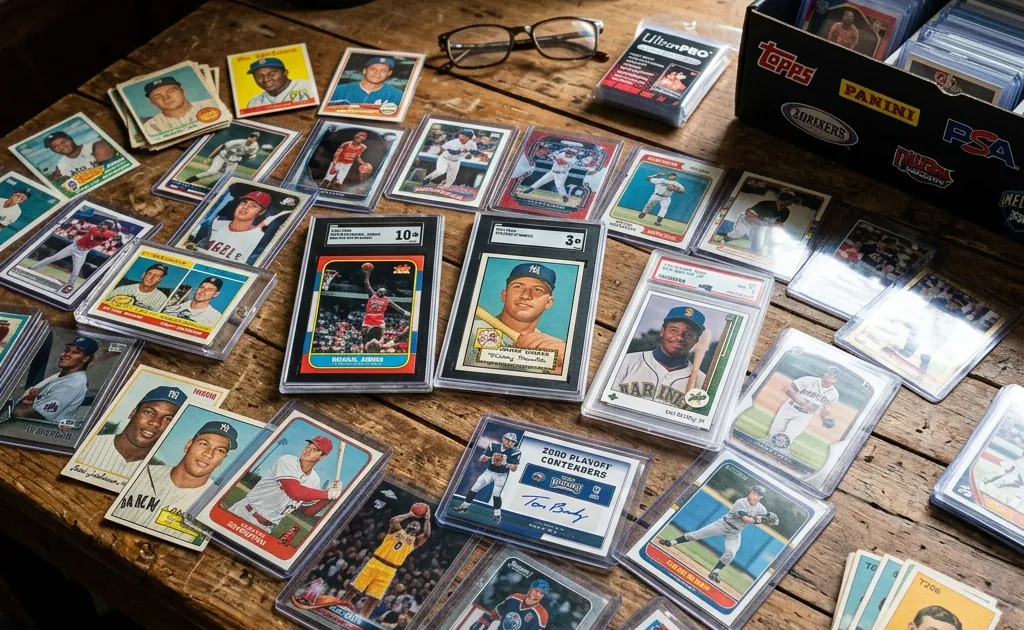
To identify a baseball card, combine the release year, manufacturer, product or set, player, and card number, then verify the variation against a reliable checklist. A player name or familiar photograph is a starting clue, not a complete identity.
Start with readable images of both sides. Copy what is actually printed before accepting a scanner suggestion or searching for a price. This guide gives you a repeatable evidence ledger and a worked example using official manufacturer checklists. It is an identification workflow, not an authentication test or an appraisal.
The five fields to collect first
You do not need to solve every detail at once. Separate the fields you can read from those you are inferring, then use the confirmed details to investigate the rest.
| Field | Where to investigate | What to avoid assuming |
|---|---|---|
| Player or subject | Name on the front and back; all subjects on a multi-player card | That every card depicts only one player |
| Manufacturer | Printed logos, copyright and licensing text | That a team logo identifies the card maker |
| Product and set | Product wording, design, and the matching manufacturer’s checklist | That every card from one company belongs to its main base set |
| Release year | Printed date clues checked against the product reference | That a statistics season or anniversary design is the release year |
| Checklist number | The card number, including any letter prefix | That a serial stamp or slab certification number is the checklist number |
Add the parallel, insert, variation, and condition status after these fields are reasonably established. A baseball card scanner can suggest a candidate, but your evidence should explain why that candidate fits.
Step 1: photograph evidence, not just the player
Take one image that shows the complete front and another that shows the complete back. Include edges and corners rather than cropping to the player’s face. Add a detail image for small print or a reflective serial stamp if the full-card view is not readable.
Change the light angle when glare hides text. If a protective holder causes reflections, first try repositioning the light and camera. Do not remove a card from protection if you cannot do so safely. Our scanner photography walkthrough covers framing and lighting in more detail.
Keep an unedited original alongside any crop you use for research. If you later ask someone else to help, the full image lets them inspect details you may not yet know are important. Do not use an enhanced or reconstructed character as evidence for a number you could not read in the original.
Topps’ product-support guidance asks collectors seeking card information for clear front-and-back photos and known product, year, player, and series details. That is also a useful starting packet for your own research; it is not a promise that support can identify or price every historical card.
Step 2: distinguish the checklist number from other numbers
Copy the complete card number, including letters, hyphens, or other printed parts. Do not reduce an alphanumeric identifier to its final digits. Search for that full identifier within the appropriate checklist section.
Several other numbers can appear on or around a card:
- A statistics table contains seasons and performance figures.
- A copyright line supplies a date clue and rights information.
- A serial stamp such as
17/99describes a numbered example, not its position in the base checklist. - A slab label can include a certification number belonging to the grading service.
- A production code in fine print is not automatically the card’s public checklist number.
Treat 17/99 here as an illustration of number formatting, not a reported card or a sale example. Record the whole stamp separately. Even after you find the correct checklist entry, a serial stamp, finish, autograph, or image may require a further variation check.
If the number is unreadable, leave the field unresolved. Try the player and product wording, then compare the candidate checklist entries against both sides of the card. A blank field is safer than a confident-looking number copied from the first search result.
Step 3: establish the product before choosing a year
Write down the exact product words you can see. Keep a separate note for a tentative product if you recognize the design but cannot read the name. A company name alone may lead to many unrelated checklists.
Use the manufacturer’s Topps checklist directory for Topps products, selecting the exact release rather than a similarly named product. For another manufacturer, look for that manufacturer’s release documentation. A reference for a different product is not made relevant simply because the player and card number happen to match.
Treat a copyright date, the last season in a statistics table, and a year printed in a retro design as different clues. Record each where it belongs. If they conflict, do not force them into one year; compare the full front and back with the candidate release reference.
Likewise, a design that resembles an older set does not by itself establish an original vintage issue. Check whether your candidate is an original release, later reprint, anniversary card, or another product using a familiar design. Identification can narrow the question, but it cannot establish physical authenticity from a resemblance alone.
Step 4: verify an entry, not just a search-result title
Once you have a likely product and year, open its checklist and find the player or card number. Check the section heading as well as the row. A base-set entry and an insert entry serve different purposes even when they appear in the same PDF.
Ask four questions:
- Does the checklist belong to the product and year I am investigating?
- Does the complete card number match?
- Does the player or group of subjects match?
- Do the physical details agree, or is a variation still unresolved?
Checklists are evidence about a release, not proof that the physical card in your hand is genuine. They also do not turn a partial match into a confirmed parallel. Keep that distinction visible in your notes.
Worked example: why “card number 1” is incomplete
Two official Topps checklists demonstrate the problem:
| Official release reference | Base-set number | Subject listed |
|---|---|---|
| 2024 Topps Baseball Series 1 checklist, page 1 | 1 | Ronald Acuña Jr., Atlanta Braves |
| 2025 Topps Series 1 checklist, page 1 | 1 | Shohei Ohtani, Los Angeles Dodgers |
The number repeats, while the release and player change. The lesson is not to memorize these two entries. It is to keep the release context attached to every card number you record.
For the first entry, a research label could begin 2024 Topps Series 1 — Ronald Acuña Jr. — #1. You would still need to compare the actual card’s image, finish, and other attributes before marking its version as confirmed. This is a checklist demonstration; no physical card was scanned, graded, authenticated, or valued for it.
Step 5: keep the variation question open until supported
A base checklist match is not the end of identification. Record any color or foil differences, printed variation wording, serial stamp, alternate photograph, autograph, or memorabilia feature. Use the release’s own documentation to investigate the attributes that matter for that product.
Do not apply one universal shortcut to every release. A color seen under a warm light can be misleading, and an unreadable code does not become reliable because a forum post supplies an attractive answer. Capture the relevant detail, note the source of the proposed match, and ask what evidence would distinguish it from the alternatives.
If you can confirm only the base identity, write something like “product and checklist entry matched; parallel unresolved.” That is a useful research result. It prevents an uncertain finish from silently becoming a specific high-value variation in your collection record.
Use this identification evidence ledger
Create one record per card or clearly identified group. The table below is an original research worksheet, not a manufacturer form or a record of app performance.
| Field | Observed evidence | Candidate or conclusion | Next check if uncertain |
|---|---|---|---|
| Subject | Copy readable names from the card | Player or multi-player entry | Compare the complete checklist row |
| Date clues | Copy printed dates and their context | Tentative release year | Check the matching product reference |
| Product | Copy logos and product wording | Manufacturer, product, series | Reject similar but different products |
| Number | Copy the full checklist identifier | Candidate entry | Inspect prefixes and section headings |
| Version | Record finish, image, stamp, and special features | Base, insert, parallel, or unresolved | Compare release-specific evidence |
| Source | Save the checklist URL, section, and review date | Reason for accepting the candidate | Replace a weak source if needed |
| Confidence | Separate observed facts from assumptions | Confirmed fields and remaining questions | Stop pricing until decisive fields agree |
Keep notes short enough to revisit. “Looks right” does not explain a match. “Player and complete number match the cited base-set checklist; finish not confirmed” tells the next reader exactly where to continue.
For several similar cards, give each its own inventory ID before combining records. Otherwise, a photo from one copy can become attached to another copy’s condition or numbering. This is especially important when you are preparing a collection for sale or sharing research with someone else.
What to do when two candidates remain
Choose the next check that separates the candidates. If the disagreement is the product, inspect product wording and the card back. If it is a parallel, capture the finish or numbering. If it is a possible reprint, look for the release details that differ and seek a suitable specialist if authenticity remains material to the decision.
Do not average the identities, borrow a sale price from each, or choose the result with the higher value. Keep both candidates in your notes and leave the disputed field unresolved. Repeatedly submitting the same unclear photograph is not new evidence.
You can also decide to stop. An unidentified card can stay in an “additional research” group without blocking the rest of your collection. Store it safely, retain its images, and return when a better reference or clearer detail is available. Our card-storage guide explains protective handling and organization.
Move to value research only after the identity is usable
A usable identity names the release, product, subject, complete checklist number, and any variation relevant to the comparison. It also states whether the card is raw or carries a professional grade. Unresolved authenticity or condition questions should remain explicit.
Then follow the free baseball value-lookup process to investigate comparable sales. The valuation methodology explains why an estimate needs matching evidence and why a displayed number is not a guaranteed sale price. If someone needs formal documentation, read value checker versus appraisal before choosing a service.
Use SportsCardValue’s baseball scanner workflow to organize the starting candidate, not to replace these checks. The useful outcome is a record another collector can verify, with uncertainty stated plainly.
Source review: October 19, 2026. The worked example was checked against the official Topps release PDFs linked above. No recognition test, sale-price study, or authenticity assessment was performed for this guide.
Identify and Research Your Sports Cards
Download the Sports Card Scanner & Value app to identify, catalog, and track baseball, basketball, and football cards. Confirm the exact card and condition before relying on an estimate.