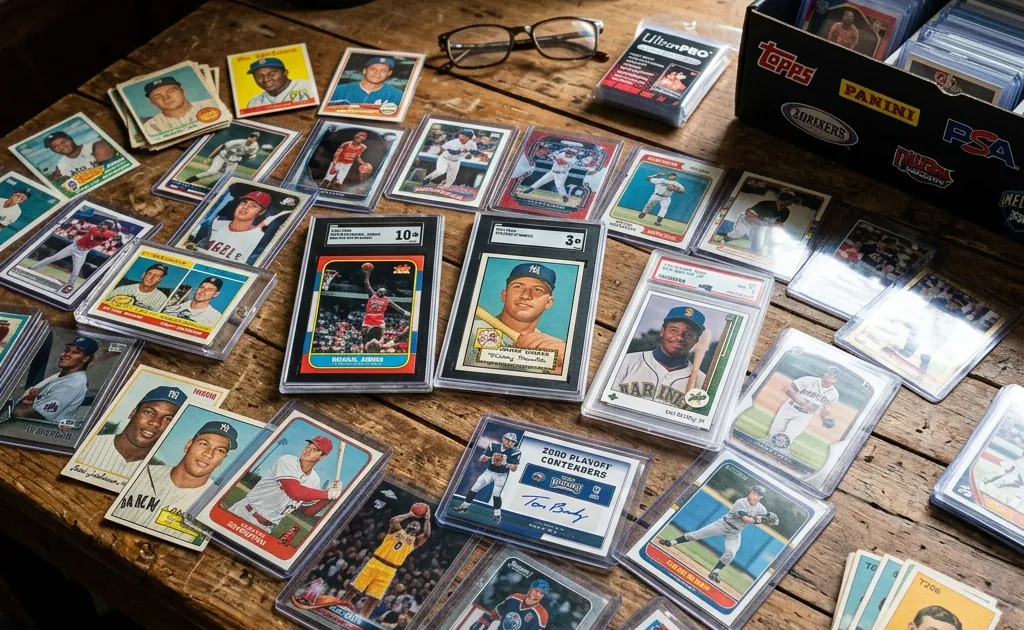
Shohei Ohtani has several important 2018 rookie cards. There is no single “Ohtani rookie price.” First identify the set, card number, image or variation, autograph status, serial number, and condition. Then compare only completed transactions for that exact issue. This guide helps you do that without treating a headline auction as a universal value.
Start with an identity record
Modern Ohtani cards often share a year and player name while differing in product, image, parallel, or autograph format. Capture the front and reverse before searching.
| Field | What to record | Why it matters |
|---|---|---|
| Year and manufacturer | Usually 2018 Topps, Bowman, or another named product | A year alone does not identify a card. |
| Card number | For example, Topps Chrome #150 or Topps Series 1 #700 | Search results can mix base cards and inserts. |
| Product and release | Chrome, Series 1, Heritage, Bowman Chrome, etc. | Each has a different supply and collector audience. |
| Image or variation | Pitching, batting, refractor, color, short print, or insert | Image and parallel are part of the identity. |
| Serial number | Record the denominator exactly, such as /499 or /25 | A serial-numbered parallel needs a matching cohort. |
| Autograph | On-card, sticker, certified, or no autograph | Do not compare signed and unsigned copies. |
| Condition and certification | Raw or exact service/grade/certification | Grade and label can materially change the comparison. |
Use official checklists and PSA’s CardFacts database to verify that a card number and variation exist. A checklist confirms an issue; it does not establish today’s market value.
Separate the major 2018 issues
The 2018 Topps Chrome #150 is a prominent modern rookie issue, but the pitching and batting images and their variations must be recorded separately. The 2018 Topps Series 1 #700 is a paper flagship issue. Topps Heritage #17 uses a different design and product context. Bowman Chrome autograph cards form another research cohort with distinct autograph and serial-number fields.
Do not merge base Chrome, refractor, color refractor, image variation, short print, and autograph results into one range. A query containing “Ohtani rookie” can return all of them. Search with the product, card number, variation, and grade in the same phrase.
Condition and modern surface checks
Modern chrome and foil surfaces reflect light, so inspect at several angles. A sleeve can create a reflection that resembles a scratch. A phone photograph can also hide print lines, dimples, or edge chipping.
| Inspection area | What to check | Evidence to retain |
|---|---|---|
| Centering | Border and image alignment front and back | Straight-on images without perspective distortion. |
| Corners | Whitening, bends, or soft tips | Four close corner photographs. |
| Edges | Chipping, rough cuts, or color loss | Notes for each edge and location. |
| Chrome surface | Scratches, dimples, print lines, roller marks | Angled-light photographs and a written description. |
| Color and image | Fading, streaks, or a different image variation | Compare with an official checklist image. |
| Reverse | Card number, copyright, serial number, and autograph details | A clear reverse photo at matching scale. |
PSA’s grading standards explain how centering, corners, edges, and surface work together. Do not describe a raw card as “PSA 10 condition.” Say what you observed and leave the grade uncertain until a grader evaluates it.
Research sold comparisons
For a useful estimate, collect several completed sales of the same issue and condition. Include the sale date, marketplace, grade, image or parallel, serial number, autograph status, and the amount actually shown as sold. Exclude asking prices, bundled lots, cards with a different image, and listings whose grade or number cannot be verified.
Ohtani comparable-sale ledger
| Candidate | Product/card/variation | Grade | Sale date | Sold amount | Include? |
|---|---|---|---|---|---|
| A | 2018 Topps Chrome #150 base | raw | |||
| B | 2018 Topps Chrome #150 exact parallel | PSA 9 | |||
| C | 2018 Topps Series 1 #700 | PSA 10 | |||
| D | Bowman Chrome autograph, exact set/parallel |
The purpose of the ledger is to expose missing evidence. If you cannot find three reasonably comparable sales, label the result “insufficient comparable data.” Do not fill the gap with a different Ohtani issue simply because the player and year match.
Autographs and serial-numbered parallels
An autograph card needs more fields than a base card. Record whether the signature is on-card or a sticker, whether the card is certified, the exact autograph grade if present, and the serial denominator. A color parallel such as /50, /25, /5, or a 1/1 needs an exact parallel name and checklist confirmation. Do not infer scarcity from a color alone.
For a serial-numbered card, photograph the serial number and search using the exact denominator. A “/50” sale is not a substitute for a “/25” sale. For an autograph, verify the set checklist and certification language before treating a listing as comparable. A seller’s phrase like “rare auto” is not evidence by itself.
Should you grade a modern Ohtani card?
Grading is a cost-and-evidence decision. List submission, shipping, insurance, and turnaround costs. Then compare the conservative likely grade with real sales for that grade. Do not assume that a visually clean chrome card will receive a gem grade, and do not use an exceptional autograph sale as the expected outcome for a raw base card.
| Observation | Next step |
|---|---|
| Visible dimple, scratch, crease, or edge chip | Record the flaw and research raw or lower-grade comparisons. |
| Clean surface but uncertain centering | Photograph both sides and compare with the published standards. |
| Certified slab with a readable number | Verify the certification and match the exact label. |
| Autograph or serial number unclear | Stop the price search and verify the checklist first. |
| Sale, insurance, or estate decision | Ask the appropriate professional whether authentication, grading, or appraisal is required. |
Scanner workflow
The SportsCardValue scanner may help suggest a candidate identity. Confirm the printed year, manufacturer, product, card number, variation, serial number, and autograph status before using the result in the ledger. A scanner cannot reliably inspect every chrome surface defect or certify an autograph. Treat the result as a starting hypothesis and keep the final identity record with the card photos.
Build modern-card cohorts before you estimate
Modern Ohtani searches can look precise while still combining incompatible cards. Create one cohort for each exact product and variation, then add condition and certification as separate fields. A base 2018 Topps Chrome #150, its refractor, and a numbered color parallel may share a photograph style but do not share the same supply or comparable-sale set. A paper Topps Series 1 #700 should not fill a missing Chrome row. If the checklist does not name the variation clearly, pause the estimate and resolve the identity first.
The same rule applies to autographs. Keep on-card signatures, sticker signatures, authenticated signatures, and unsigned cards separate. Record the autograph grade only when the label identifies one. For a numbered card, write the exact numerator and denominator from the card, not a seller’s shorthand. A claimed “short print” or “super rare” description is a lead for research, not evidence of scarcity.
Use plain labels in the final result: “identified, but insufficient comparable sales,” “raw estimate pending condition review,” or “certified exact-grade cohort.” These labels tell the reader what is known and what still needs work. Include the last checked date for every sale and note whether the displayed amount excludes shipping or buyer fees. If a card is being considered for a major purchase, inheritance, insurance, or consignment, recommend the appropriate professional service rather than presenting a web search as an appraisal.
This cohort method makes future updates faster. When a new sale appears, add it to the exact product row without rewriting every conclusion. When a checklist, grading fee, or marketplace policy changes, update that field and preserve the original review date in your notes.
Example evidence note
Imagine a listing titled “Ohtani Chrome rookie refractor” with no card number and a serial number hidden by the sleeve. It is not yet a usable refractor comp. Photograph or request the reverse, record the product and denominator, and verify the checklist before entering it. If the card turns out to be base #150, move it to the base cohort rather than averaging it with refractors. A careful “identity unresolved” note is more valuable than a precise-looking number built from the wrong variation.
For a purchase, ask for a straight-on front and reverse image, a close-up of the serial number, and an angled-light surface photograph. Compare the seller’s images with the checklist image and look for a changed image variation, a missing foil stamp, or a serial number that does not match the advertised parallel. Keep autograph cards out of a base-card price model even when the listing calls the signature an “upgrade.” Save the invoice, listing URL, and photographs; if the card is later graded, those records explain why the original raw observation and the slabbed result are different evidence points.
Do not use the phrase “most expensive” as a research conclusion without defining the comparison set and date. A one-of-one autograph, a numbered parallel, and a base Chrome card answer different questions. State whether you are comparing base issues, all 2018 rookie cards, certified grades, autographs, or public auction results. If the available sales are too sparse, say so and provide the identity and documentation steps instead of manufacturing a ranking.
Editorial sources and review date
This page was reviewed October 29, 2026. Identity references use PSA CardFacts, PSA grading standards, and official manufacturer checklist information where available. Marketplace data, grading fees, and population counts are time-sensitive; recheck them at the time of a purchase or sale.
Related guides
Identify and Research Your Sports Cards
Download the Sports Card Scanner & Value app to identify, catalog, and track baseball, basketball, and football cards. Confirm the exact card and condition before relying on an estimate.