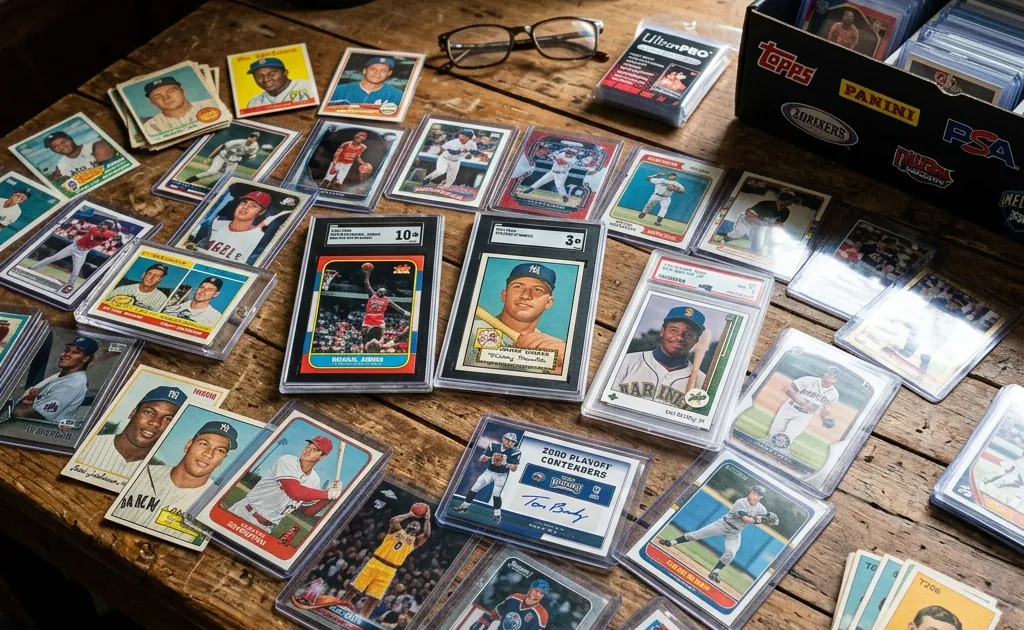
To check a basketball card’s value, identify the exact product and variation first, then compare recent completed sales for cards in a similar condition. An asking price is a seller’s proposal; it is not evidence that a buyer paid that amount. A responsible estimate records the source, date, grade or raw condition, and any mismatch.
Start with the basketball card scanner if you need a candidate identification. Then verify it using the Prizm parallel identification guide and the card itself. This workflow produces a research estimate, not a certified appraisal.
Step 1: write an exact card description
Before opening a marketplace, write a one-line description containing year, manufacturer, product, player, card number, insert or parallel, serial number, and condition status. For example: “2023–24 Panini Prizm Basketball, player name, card number, Silver parallel if verified, raw, surface not fully inspected.”
Do not shorten the description to a player name. A single player can have base cards, rookies, inserts, autographs, numbered parallels, and multiple products in one season.
| Field | Evidence to save | Value risk if missing |
|---|---|---|
| Year and product | Copyright line, checklist, packaging | Wrong product comps |
| Card number | Back of card and checklist | Base/insert confusion |
| Parallel or serial | Printed name, pattern, full stamp | Scarcity assumption |
| Condition | Front, back, corners, edges, surface photos | Raw cards are not equivalent |
| Grade | Slab label and cert details when present | Grade premium misread |
| Sale date | Marketplace record | Old markets may be stale |
Step 2: use completed sales
Use a marketplace’s completed or sold filter where available. eBay’s pricing guidance explains how to use Advanced Search and choose Completed listings when researching market activity. Keep the item title, sale date, sold amount, shipping treatment, condition, grade, and listing URL in your notes.
Do not copy an unsold Buy It Now amount into a value estimate. Unsold listings can be useful for understanding competition, but they do not demonstrate a transaction. A canceled or accepted-best-offer listing may also need cautious interpretation because the displayed amount may not equal the final paid amount.
Step 3: match like with like
Build a small comparison set. Match the product and card number first, then the parallel, serial range, grade, and condition. If exact matches are scarce, widen only one attribute at a time and label the resulting estimate as lower confidence.
| Comparison | Use directly? | Reason |
|---|---|---|
| Same product, player, number, parallel, and grade | Yes | Closest available evidence |
| Same card raw versus graded | No, separate | Holder and grade change the comparison |
| Same player, different product | Usually no | Product demand differs |
| Same parallel name, different year | No without explanation | Numbering and supply differ |
| Same card, older sale | With date noted | Market context may have changed |
Never choose the highest sale as the “value” without showing the rest of the sample. A range or median may communicate uncertainty better than a single number.
A five-sale worksheet
For each candidate sale, complete one row:
| Sale | Date | Exact match? | Raw/grade | Sold amount | Notes |
|---|---|---|---|---|---|
| 1 | |||||
| 2 | |||||
| 3 | |||||
| 4 | |||||
| 5 |
Then mark each row as exact, close, or excluded. Exclude listings where the card number is hidden, the parallel is unclear, the grade does not match, or the transaction appears bundled. Explain exclusions instead of silently deleting inconvenient evidence.
Condition and grading
For a raw card, inspect centering, corners, edges, and surface in good light. PSA publishes grading standards that describe the features graders consider; those standards are a reference, not a promise that your card will receive a particular grade. If a card is already slabbed, copy the grading company, grade, and certification number. Do not infer authenticity or grade from a photograph alone.
Prizm and other chrome-style cards can show scratches, print lines, dimples, and edge chipping. Record those observations separately from a potential grade. A raw card with an attractive front image may still compare poorly with a clean graded example.
Interpreting a small sample
Five sales are a worksheet target, not a rule that every card has five usable comps. If you find one exact sale and several close matches, say so. If you find no exact sale, explain which attributes were widened. A small sample should widen your confidence interval, not encourage a confident price.
Avoid false precision. “Recent exact sales clustered around the same broad range” can be honest when the sample is thin. Do not fabricate a range, average, or example amount. Any illustrative calculation in your private notes should be labeled as an example and kept separate from published market evidence.
Raw, graded, and appraisal decisions
The question “What is this card worth?” may mean different things: a selling estimate, insurance documentation, an authentication opinion, or a formal appraisal. The value checker versus appraisal guide explains the boundary. A scanner can support identification and research; it does not turn a research estimate into a certified appraisal.
Use the sports card value checker versus appraisal guide when deciding whether you need research or formal documentation. Use the sold-price versus asking-price guide when a listing seems unusually high. For broader methods, revisit how to value sports cards, which covers identification, condition, and comparable sales across sports.
A decision matrix for the next action
| Evidence state | Best next action |
|---|---|
| Exact identity and several recent exact sales | Record a dated estimate range and source links |
| Exact identity but one or no exact sales | Save close comps and label low confidence |
| Identity known but parallel unresolved | Finish checklist and serial-number research |
| Raw card with uncertain condition | Photograph and describe condition before pricing |
| Possible high-value card with authentication questions | Seek qualified professional advice |
This matrix keeps the workflow useful even when the answer is “research more.” It also prevents a search-result headline or an unsold listing from doing the work of identification and evidence.
Worked comparison: deciding whether a comp is usable
Imagine your worksheet describes an ungraded 2023–24 Prizm base card with a clearly verified card number, while a search result shows a graded Silver Prizm from the same player. The player match is useful for discovery, but the result is not an exact comp: the parallel and grade are different. Mark it “close, exclude from direct range,” then continue looking for the base card or the same Silver card in the same condition. If only that one result exists, report that the sample is thin instead of converting the graded sale into a raw-card price.
Now imagine two raw sales that match the product and number but one has a visible surface scratch. Keep both rows, describe the scratch, and decide whether your card is closer to the clean or damaged example. This is a comparison decision, not a grading prediction. Your note might say “identity exact; condition closer to row 2; confidence moderate.” That statement is more useful than an unsupported single amount.
The same logic applies to a numbered parallel. A /199 card and an unnumbered Silver card may share a player and design family, but they do not establish the same supply or buyer demand. Record the denominator, parallel name, and source separately. If the listing title omits those details, inspect photographs or exclude it.
Fees, shipping, and bundles
Read the listing record closely before treating a displayed amount as a card-only sale. Shipping may be shown separately, a listing may contain multiple cards, or a lot may combine base cards with a parallel. Record whether the amount is for one card or a group. If you cannot separate the components, exclude the lot from an exact comparison.
Fees matter when deciding what you would actually keep after a sale, but they do not change the historical amount a buyer paid. Keep market evidence and net-proceeds calculations in separate columns. The selling guide covers marketplace choices and transaction records; this article is limited to establishing a defensible basketball-card estimate.
Time, player news, and seasonality
Basketball markets can react to a draft, injury, trade, playoff run, or award. Note the sale date and the relevant season rather than presenting a stale sale as a current guarantee. A cluster of sales from one eventful week can be informative, but it may not describe a normal market. Use the date as context, not as an excuse to invent a trend.
Do not write that a player’s card will rise or fall. A research guide can describe observed transactions and the uncertainty around them; it cannot predict performance or investment return. If you publish a dated example later, update it when the source no longer represents the current question.
Quality control before sharing an estimate
Run this short check before sending your worksheet to another collector:
- Can another person identify the same product and card number from your notes?
- Did you separate base, insert, parallel, serial range, and grade?
- Does each included sale have a date and source?
- Did you exclude or label lots, unclear titles, and unmatched conditions?
- Did you describe an estimate as an estimate rather than a guaranteed price?
If any answer is no, keep researching. The purpose of a worksheet is reproducibility, so a second reader should be able to find the same evidence and understand why a row was included.
Editorial evidence note
Sources and links were reviewed on October 28, 2026. Marketplace interfaces, listing histories, and product checklists change; retain dated source records for any published example. This guide intentionally avoids invented sales, prices, app tests, and claims about scanner accuracy. The SportsCardValue Editorial Team provides educational value-research guidance, not certified appraisals.
Identify and Research Your Sports Cards
Download the Sports Card Scanner & Value app to identify, catalog, and track baseball, basketball, and football cards. Confirm the exact card and condition before relying on an estimate.