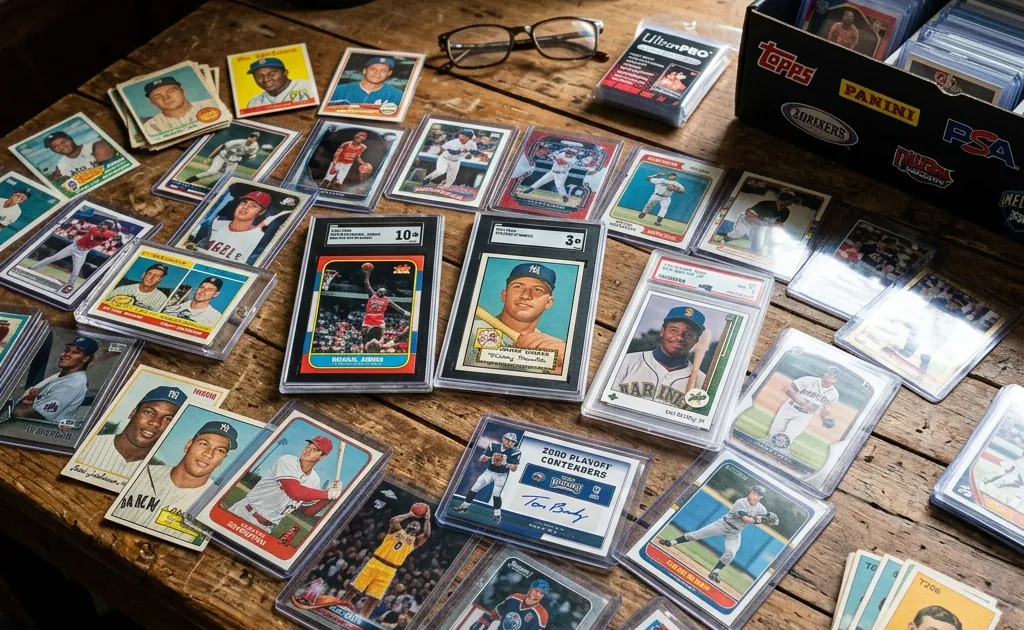
Grade a sports card before selling it only when the likely benefit of a trusted label is worth the service cost, shipping, insurance, time, and uncertainty. If the card’s identity is unresolved or its condition is difficult to document, pause and gather better evidence. Once those facts are clear, selling raw may be the better choice if a conservative graded-sale scenario does not cover the costs. A higher grade is a possibility, not a result you can promise before submission.
This guide helps you make that choice without pretending to predict a grade or a future sale. It separates three decisions: whether the card is identified, whether its condition is documented, and whether grading improves the selling plan. Use the raw versus graded comparison guide for market cohorts and the condition guide for the inspection step.
For the full identification-to-estimate process, follow the sports card valuation guide and keep the grading decision alongside its source evidence.
Start with identity, not grade potential
Before deciding, record the year, manufacturer, product, card number, player, base or insert status, parallel, serial number, autograph or memorabilia wording, and variation. A scanner can suggest a candidate; confirm it against a checklist, label, or other primary source. A similar player image is not enough.
An unresolved identity makes a grading decision premature. A service may describe the card differently from the marketplace listing, and a grade cannot correct a wrong product or parallel. Keep a stop note if the front and back do not support one confident identity.
| Identity question | Evidence to collect | Decision if unresolved |
|---|---|---|
| Is the year and product confirmed? | Manufacturer checklist or release reference | Pause; do not submit yet |
| Is the card number visible? | Clear front and back photographs | Request better images or inspect safely |
| Is the parallel or serial range known? | Printed finish, numbering, checklist | Keep as an uncertain candidate |
| Is the autograph or relic wording exact? | Card text and product documentation | Separate from ordinary base-card research |
The sports card scanner is useful for organizing a candidate, but a scan is not an authentication or grading result. Treat the identity record and the grading decision as separate columns.
Inspect condition without predicting a number
Look at corners, edges, surface, and centering under even light. Photograph both sides and note print lines, scratches, dents, creases, stains, chipping, trimming concerns, and holder glare. A photograph can miss a surface issue, and perspective can distort centering. State what you could not inspect.
PSA publishes its grading standards, while Beckett publishes grading information. These documents describe each service’s framework. They are not a universal conversion chart, and your notes are not a service grade.
Use a simple confidence record:
| Observation | What you saw | Confidence | Follow-up |
|---|---|---|---|
| Corner condition | Sharp, soft, or obscured | High/medium/low | Retake close photo if low |
| Edge condition | Clean, chipping, or hidden | High/medium/low | Photograph the back edge |
| Surface | Lines, dents, print marks, or glare | High/medium/low | Change light angle |
| Centering | Approximate border relationship | High/medium/low | Avoid exact claim from angled photo |
| Alteration concern | None observed or unresolved | High/medium/low | Seek specialist advice |
“Looks like a nine” is not a condition record. A trustworthy selling decision can be made with uncertainty visible; it does not require an optimistic grade forecast.
What grading can add to a sale
A recognized holder can communicate that a service examined and labeled the card under its process. It may make identity, condition format, and certification easier for a buyer to understand. Some buyers prefer a particular service or label. Those are practical reasons to consider grading.
Grading does not guarantee authenticity, a particular grade, a faster sale, or a higher net result. Read the service’s current submission terms, declared-value rules, turnaround descriptions, and authentication options before paying. PSA’s certification verification tool is useful after a label exists, but a matching number alone is not proof that a photographed holder is genuine.
Keep service names separate. PSA, Beckett, and SGC may use different labels, subgrades, qualifiers, and authentication offerings. A PSA observation and a BGS observation are not interchangeable rows in a sold-comps table. The PSA versus BGS versus SGC guide covers those label comparisons.
The ready, hold, or sell-raw framework
Use the strongest answer supported by your evidence rather than the most exciting possible outcome.
| Result | Identity | Condition record | Selling context | Action |
|---|---|---|---|---|
| Ready to evaluate | Exact identity confirmed | Front, back, and key defects documented | Graded comps exist for the same service and grade bands | Calculate costs and compare conservative scenarios |
| Hold for evidence | Identity likely but a parallel, number, or defect is unclear | Important surface or back detail hidden | Comparable group is mixed or too sparse | Improve photos, verify checklist, or seek advice |
| Sell raw | Identity confirmed | Condition can be described honestly | Grading costs or timing do not fit the sale | List raw with clear photos and disclosures |
| Seek specialist help | Identity or authenticity is disputed | Alteration, counterfeit, or autograph concern | Buyer or insurer needs specialized documentation | Ask a qualified service or specialist |
The “ready” row does not mean “submit.” It means the inputs are good enough for a cost and market comparison. If the only support for grading is hope that the card will receive the highest possible label, the safe result is hold or sell raw.
Compare conservative selling scenarios
Make two or three scenarios, and write down assumptions. A raw scenario includes preparation, photos, packaging, marketplace fees, shipping, and expected time. A graded scenario includes the chosen service tier, shipping to and from the service, insurance or declared-value requirements, packaging, possible return or resubmission costs, and the time the card is unavailable. Do not silently subtract those costs from a market comparable that reports only an item amount.
Use the sold-price versus asking-price guide to keep completed transactions separate from active requests. Use How to Sell Sports Cards for venue and net-result planning.
| Input | Raw sale | Grade first |
|---|---|---|
| Card identity confidence | Record | Record |
| Condition evidence | Photos and notes | Photos and notes before submission |
| Service and tier | None | Current terms checked on date |
| Shipping and insurance | Outbound sale | To service, return, and final sale |
| Time cost | Listing and fulfillment | Submission wait plus listing |
| Market evidence | Matching raw cohort | Matching service/grade cohort |
| Downside | Buyer disputes condition | Lower grade, qualifier, delay, or no meaningful premium |
The conclusion may be “sell raw now,” “hold until the card is identified,” or “submit after confirming the cost.” A useful answer does not need a price prediction.
When grading before selling is usually a poor fit
Pause when the card is hard to identify, the key surface is hidden, or the listing would need a grade claim to attract attention. Also pause when the service’s current terms are unclear, the sale is time-sensitive, or the comparison group combines raw cards with several services and grades.
Selling raw can be more transparent when the card has visible wear, a common base-card identity, or a market where buyers already understand ungraded condition. Describe what you can see, include front and back images, disclose flaws, and avoid labels such as “gem” unless a service has actually assigned one.
Grading may fit when the identity is exact, the condition record is complete, a buyer audience values the chosen service, and conservative sold evidence supports the all-in cost. Even then, submission is a risk-managed choice rather than a promise.
Three hypothetical examples
These examples illustrate the decision method. They are not reported sales, service tests, or forecasts.
A clean-looking card with an unresolved parallel
The front image is attractive, but the checklist shows several finishes for the same product. Because the parallel is unresolved, graded comparisons would likely be mixed. Hold, verify the checklist, and then decide. Submitting first would pay for a label before solving the identity problem.
A documented card with sparse graded evidence
The year, card number, and service are clear, and photographs show a surface line. Only one comparable graded result is available. Record the line, keep the single result as context, and compare the raw-sale path. Selling raw may be more defensible than assuming the one graded observation will repeat.
An exact card with a clear audience and known costs
The card identity is confirmed, condition observations are complete, current service terms are saved, and a clean group of same-service records exists. Calculate an all-in scenario using conservative assumptions. If the result still works after shipping, fees, and delay, submission is reasonable; if not, sell raw or hold.
Write the listing honestly
If you sell raw, title the exact card and variation, show front and back images, and describe observed condition without predicting a grade. If you sell a slab, copy the service, grade, qualifier, and certification details accurately. Do not imply that a label guarantees future value.
Keep your worksheet with the listing date, source, transaction state, costs, and unresolved questions. A later refresh can then distinguish what changed in the market from what changed in the card’s description.
Editorial and source notes
Sources checked October 29, 2026: PSA grading standards, PSA certification, Beckett grading information, eBay pricing guidance, and eBay Product Research. Service terms, fees, and turnaround can change; verify them again before submission.
This article gives a research framework, not a grading opinion, authentication result, appraisal, or financial guarantee. A qualified service or specialist is appropriate when the card’s authenticity, alteration history, or documentation has material consequences.
Identify and Research Your Sports Cards
Download the Sports Card Scanner & Value app to identify, catalog, and track baseball, basketball, and football cards. Confirm the exact card and condition before relying on an estimate.